Charge Premium as a Coach
Assessment-based coaches charge 2-3x more and keep clients 3x longer. The business case for assessment-first coaching, with pricing strategy.
The pricing ceiling problem
Most personal trainers hit a pricing ceiling within their first two years. They start at $40-60 per session, inch up to $75-100 as they gain experience, and then stop. Raising prices beyond that point feels impossible because the service looks identical to what every other trainer offers: write a program, supervise the workout, count the reps.
When the service is commodity, the price is commodity. And in a market with over 450,000 certified personal trainers in the US alone (Bureau of Labor Statistics, 2025), the commodity floor keeps dropping. Online coaching platforms offer template programs for $50-150/month. AI workout generators are free. The race to the bottom accelerates every year.
The coaches who charge $200-500/month for online coaching or $150-300 per session in person share one trait: they do something measurably different. The word “measurably” is doing the heavy lifting in that sentence.
Why assessment changes the economics
Assessment-first coaching is not just a better way to coach. It is a fundamentally different business model with different economics.
Differentiation that clients can see
When a prospective client shops for a trainer, every option looks the same. “I’ll write you a customized program based on your goals.” Everyone says this. Nobody can prove it.
An assessment-based coach opens the relationship with data. Eighteen range of motion measurements. A structural pattern classification. A body map showing where constraints sit. A written brief explaining what the data means and how it changes the program.
The client receives something tangible before they even start training. They can hold it, read it, share it with their spouse, compare it to their previous trainer’s “free consultation” (which was actually a sales pitch). The assessment creates value that is visible and concrete, not promised and abstract.
This visibility solves the pricing objection. When a client asks “why do you charge more than other trainers?”, the answer is on paper. “Because I measured what your body can actually do before writing your program. Here are the 18 data points. Here is what they mean. Here is how they changed your program. Your previous trainer guessed. I measured.”
Retention that compounds
The industry average for personal training client retention is 3-6 months. After the initial motivation fades, the client stops seeing progress (because the program was based on a guess, not a diagnosis), and they leave. The trainer spends 30-40% of their time on sales and marketing to replace churned clients.
Assessment-based practices see different retention numbers. When a client’s program is built on structural data, two things change:
-
Progress is measurable beyond performance. The client might not add weight to the bar every week (nobody does long-term). But their hip internal rotation improved 8 degrees. Their structural pattern shifted from Pattern 1 toward neutral. Their asymmetry index decreased. Progress is happening at the structural level, and the data proves it — even during periods when performance plateaus.
-
The coach-client relationship deepens. Assessment data creates a shared language. Instead of “how do you feel?”, the check-in becomes “your left hip IR gained 5 degrees since last assessment, which means we can progress your squat depth now.” The client understands that their coach is tracking something specific and making decisions based on evidence. This builds trust in a way that personality alone cannot.
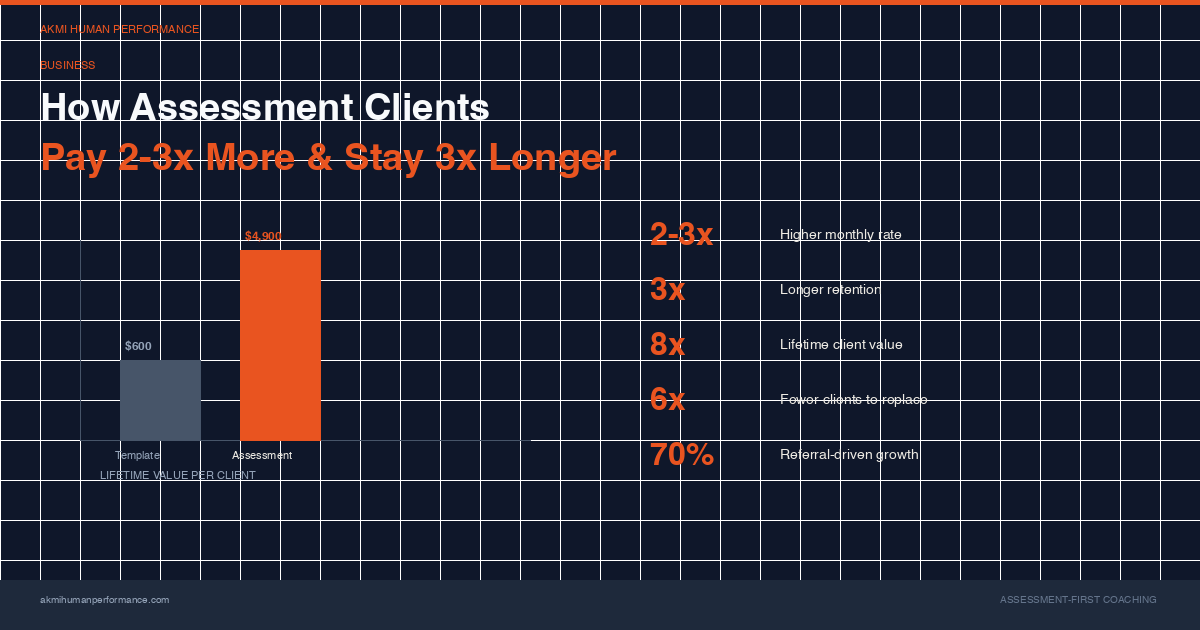
The result: assessment clients stay longer. Our internal data shows average retention of 14+ months for assessment-based coaching relationships, compared to the industry average of 4-5 months. That 3x difference in retention is the single biggest driver of revenue growth.
Revenue math: assessment vs. template
Here is a simple comparison for a solo coach:
Template-based practice:
- Monthly rate: $150/month
- Client acquisition cost: $50-100 (ads, content marketing, time)
- Average retention: 4 months
- Lifetime value per client: $600
- Clients needed for $8,000/month revenue: 53
- Annual churn replacement: 80% of roster (42 clients/year)
Assessment-based practice:
- Monthly rate: $350/month
- Client acquisition cost: $30-50 (referrals dominate, lower marketing spend)
- Average retention: 14 months
- Lifetime value per client: $4,900
- Clients needed for $8,000/month revenue: 23
- Annual churn replacement: 30% of roster (7 clients/year)
Same monthly revenue target. The assessment-based practice serves fewer than half the clients, replaces one-sixth the churn, and generates 8x the lifetime value per client. The coach spends less time on sales, less time on content marketing, and more time on coaching.
The lower client count also means higher quality work. A coach managing 23 clients can review assessment data, write detailed briefs, and provide genuine individualization. A coach managing 53 clients at $150 each is running a factory.
How to position and price assessment coaching
Step 1: The assessment is the product, not the add-on
The most common mistake coaches make when transitioning to assessment-based pricing is treating the assessment as a free lead magnet or a bonus feature. “Sign up for 3 months and get a free assessment!”
This destroys the value. If the assessment is free, the client concludes it is not worth anything. The assessment should be the most expensive single service you offer.
Price the initial assessment at $150-300 as a standalone service. It includes the full ROM testing battery, structural classification, a written brief with findings and recommendations, and a 30-45 minute consultation to walk through the results. The client receives a document they have never seen from any other trainer.
Some clients will buy the assessment and not continue to coaching. That is fine. You earned $150-300 for 90 minutes of work, and the client leaves knowing that when they are ready for real coaching, you are the one with their data.
Most clients will continue, because the assessment creates a gap they want to close. “You have a bilateral extension pattern with significant hip IR restriction. Here is what that means for your training. Here is the 12-week plan to start addressing it. Want to begin?”
Step 2: Monthly coaching priced on value, not time
Stop charging per session. Assessment-based coaching is not a session-based business. It is a outcomes-based relationship.
Monthly pricing should reflect:
- The assessment data and ongoing tracking
- The individualized programming based on that data
- The reassessment at regular intervals (every 4-8 weeks)
- Direct access to the coach for questions and adjustments
- The expertise required to interpret assessment data and translate it into programming
At this level of service, $250-500/month for online coaching is justified and competitive. In-person coaching with assessment adds the facility, the hands-on testing, and the real-time feedback — $400-800/month is appropriate for markets that support it.
The key pricing principle: charge for the knowledge that produces the program, not the time spent delivering it. A 30-minute reassessment that changes the next 8 weeks of programming is worth more than a 60-minute workout supervision session.
Step 3: Build the reassessment cycle into the offer
Reassessment is the retention engine. Every 4-8 weeks, you retest the key ROMs, update the structural classification, and show the client their progress on a longitudinal chart. This is the moment where retention either renews or decays.
If the data shows improvement — hip IR gained 6 degrees, infrasternal angle normalized, asymmetry reduced — the client sees concrete evidence that the program is working. They re-commit.
If the data shows stagnation or regression, you adjust the program. The client sees a coach who notices problems early and responds to data, not one who runs the same program until something hurts.
Either way, the reassessment demonstrates value. It is the most powerful retention tool in coaching, and it costs you 30 minutes every 4-8 weeks per client.
Step 4: Let the data sell for you
Assessment-based practices grow primarily through referrals, not marketing. When a client receives a 6-page structural brief with 18 ROM measurements, pattern classification, and individualized recommendations, they show it to their training partner, their spouse, their physiotherapist. The document does the selling.
“My trainer actually measured my hips and told me my squat pattern needs to change because my internal rotation is restricted bilaterally. Look at this report.”
No Instagram carousel competes with that sentence spoken by a real client to a real friend. The assessment creates a referral artifact — a physical document that travels from your client to their network without any marketing effort from you.
Objection handling: what clients actually ask
“My current trainer charges $100/month and I’m happy.” “Your current trainer is great for general fitness. I specialize in structural assessment — I measure how your body moves before writing your program. If you’ve had recurring pain, plateaus, or injuries that keep coming back, the assessment will tell you why. If everything is working fine, you don’t need me.”
Acknowledge the competitor. Define your specialization. Create an honest filter. Not every client needs assessment-based coaching, and saying so builds credibility.
“Can’t you just watch me move and tell what’s wrong?” “I can make educated guesses by watching you move. But guesses are not measurements. When I measure your hip internal rotation and find 22 degrees on the right and 38 degrees on the left, that 16-degree asymmetry tells me something specific about your pelvic position that I cannot see with my eyes. Measurement is the difference between ‘your squat looks off’ and ‘your right hip lacks the rotation needed for symmetrical depth.’”
“I just want to get stronger / lose weight. I don’t care about ROM.” “Getting stronger safely requires joints that can handle the range of motion your lifts demand. If your shoulders can’t internally rotate enough for a proper bench press setup, we can still bench — but the load goes to your shoulder joint instead of your chest. The assessment tells me which lifts are safe to load heavy and which need modification. It protects your training investment.”
Connect assessment to their stated goal. Nobody cares about ROM in the abstract. Everyone cares about lifting heavy without getting hurt.
The technology layer
Running assessment-based coaching manually — paper goniometer readings, handwritten briefs, Excel spreadsheets for tracking — works, but it does not scale. At 10 clients, you can manage the paperwork. At 25, you are spending more time on data management than coaching.
The AKMI platform was built to solve this problem. ROM data entry, automatic pattern classification, brief generation, and longitudinal tracking are integrated into the coaching workflow. The assessment data connects directly to programming decisions, so the brief is not a separate document — it is the foundation of the program builder.
If you are not ready for a platform, start with the free tools. The ROM Estimator lets you enter measurements and get instant pattern probability. It is not a full platform, but it is a starting point for coaches who want to test the assessment-first model before committing to a technology investment.
The bottom line
The coaching market is bifurcating. On one end, AI and templates drive prices toward zero for generic programming. On the other end, assessment-driven coaching creates value that AI cannot replicate: structural measurement, clinical reasoning, individualized intervention based on the body in front of you.
Coaches who measure will charge more, keep clients longer, and build practices that grow through referrals instead of ads. Coaches who guess will compete on price against machines that guess faster and cheaper.
The assessment is the moat. Build your practice on it.
Start with the AKMI ROM Estimator — free structural pattern analysis from ROM measurements. Read about the full assessment methodology to understand the clinical framework behind data-driven coaching.
Assessment-first biomechanical coaching for serious lifters and competitive athletes. 18 tests, 6 structural patterns, data-driven programming. We measure what matters, then build from what we find.
LEARN MORE →Related Articles
View all →Find Your Biomechanical Coach
AKMI connects you with certified biomechanical coaches matched to your goals, language, and location. Here is how the matching process works.
BusinessOnline Training Platforms 2026
What online coaching platforms offer vs. what coaches need. Assessment integration, programming, and what separates real tools from spreadsheets.